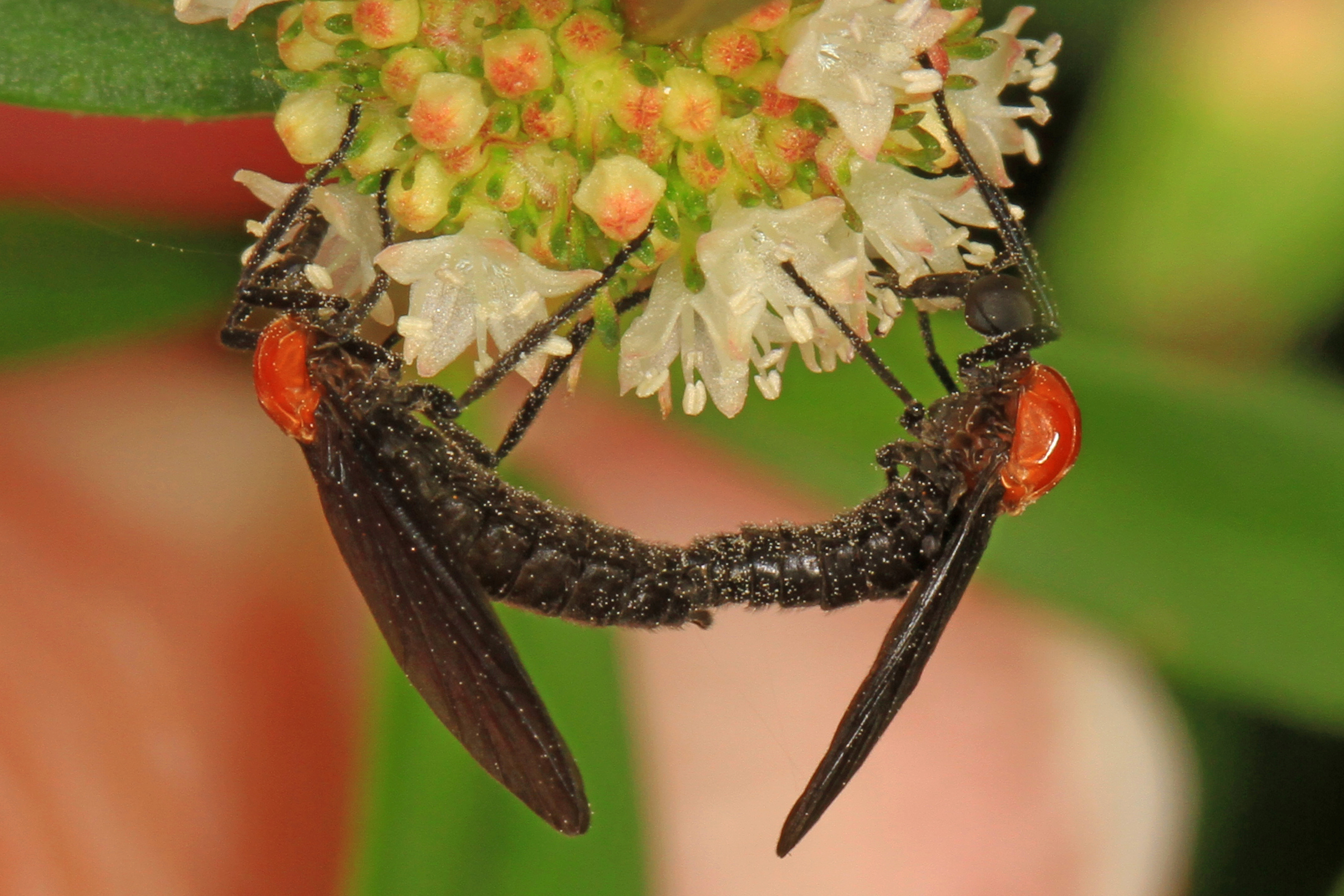
Thick clouds of lovebugs are splattering windshields and coating grilles across Wesley Chapel's Wiregrass, Meadow Pointe and Seven Oaks neighborhoods.
The small black flies, marked by a red patch behind the head, have also blanketed the Bruce B. Downs Boulevard and County Line Road corridors, turning routine drives into a cleanup chore, according to Wesley Chapel Community. The swarm is part of the species' regular fall flight, which runs from about August into September each year.
The bugs don't bite, sting or carry disease.
But they can wreck a paint job.
Lovebug body fluids are slightly acidic, according to a University of Florida Institute of Food and Agricultural Sciences Extension publication on the species. If egg masses and body parts stay on a vehicle for several days, bacterial action raises that acidity and can etch the paint.
Deby Cassill, an associate professor of integrative biology at the University of South Florida, said in a WUSF interview published May 22 that drivers should clean their cars right away. "They have an acidic body, and if they smack up against your car, you would want to get them washed off immediately because the acid will eat through some paint," she said.
Soak first, then scrub to protect your paint
UF/IFAS Extension recommends soaking the front of a vehicle with water for about five minutes, then scrubbing within 15 to 20 minutes. That process should remove most lovebugs without harming the paint. Scraping off dried residue can damage the finish, so soak first, then wipe.
A fresh coat of wax makes future splatter easier to clean. Nylon screens that hook onto the front of a vehicle, sold at auto supply stores, catch the bugs before they clog the radiator, and a hood air deflector reduces splatter, according to UF/IFAS.
When swarms peak and when they'll end
Male lovebugs hover 1 to 3 feet off the ground between 8 and 10 a.m., with a second surge from about 4 to 8 p.m., according to UF/IFAS. The bugs are drawn to highways mostly between 10 a.m. and 4 p.m., when heat and sunlight make vehicle exhaust attractive to them. Drivers who can run errands after dark will likely pick up less splatter.
Each lovebug generation in Florida lasts about four weeks, with major flights in April and May and again in August and September, according to UF/IFAS. The current fall wave should fade in the coming weeks, and the next major flight is expected in spring 2027.
Despite a long-running myth, University of Florida entomologists did not create or introduce lovebugs. The species was first collected in Florida in 1949 in Escambia County and spread across the state on its own, according to the extension publication.
Cassill said populations appear smaller than they once were. "We think that the populations are not as high as they used to be in the late '90s and early aughts," she said.
Chemical controls don't work because the bugs are so widespread and keep drifting onto roads from nearby areas, UF/IFAS says. The best defense is protecting vehicles until the swarm passes.
Coming up in Wesley Chapel
- Saturday, Sept. 26: Free car seat safety checks from 10 a.m. to 2 p.m. at Pasco County Fire Rescue Station 13, 5935 Old Pasco Road. Details at wesleychapelrecord.com.

.jpg)